
What a single shift in position does — and why it matters more than you might think.
There are two photographs in this post. Same room. Same subject. The same afternoon light coming through the same window. I took them maybe thirty seconds apart.
One of them works. One of them doesn’t. The difference is one step to the right.
The First Frame
The subject is a Wolf Model Form Co. dress form — canvas over structure, stenciled “Collapsible Model 1968” across the front, a lamp socket where a head should be. It’s been around. You can see it in the surface — the wear marks, the slight sag of the canvas, the small badge still pinned at the chest. There’s a story here.
But in the first frame, the story can’t get through.
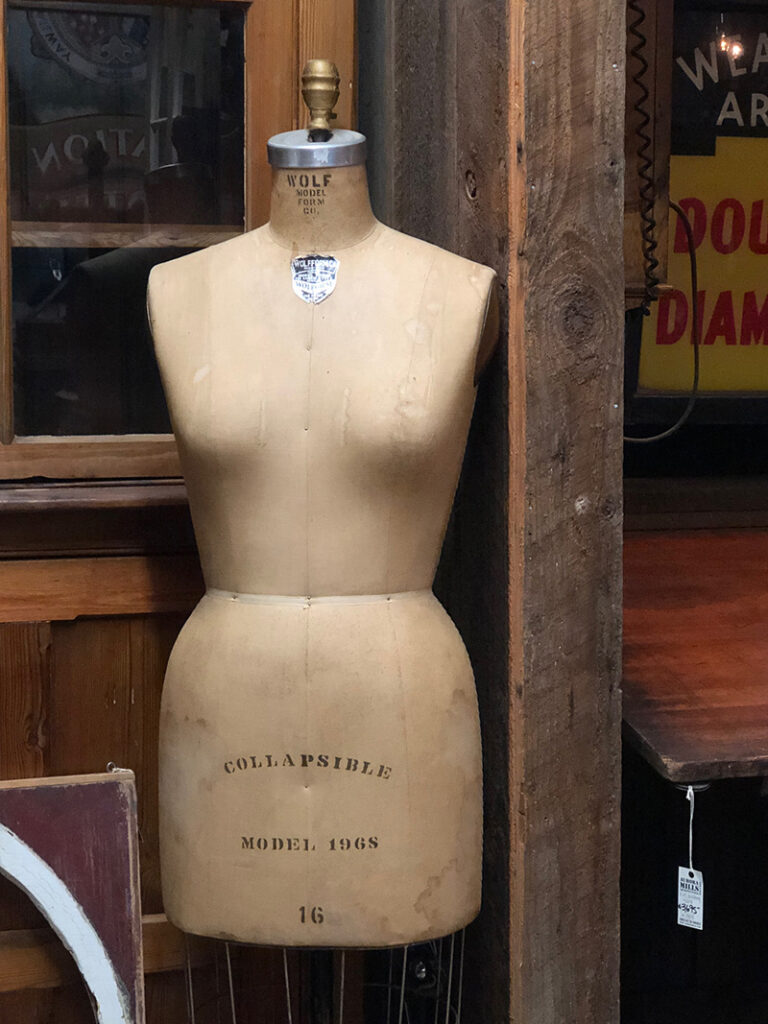
On the right edge of the frame, a yellow-and-red sign is pulling just as hard as the dress form itself. Saturated color against a neutral subject — equal visual weight on both sides of the image. The eye doesn’t know where to rest. Behind the form, the window reads as clutter: reflections, dark shapes, frames within frames, nothing resolved. The form is present. But it isn’t the subject yet. The photograph can’t decide what it’s about.
One Step
I moved one step to the right. Slightly closer.
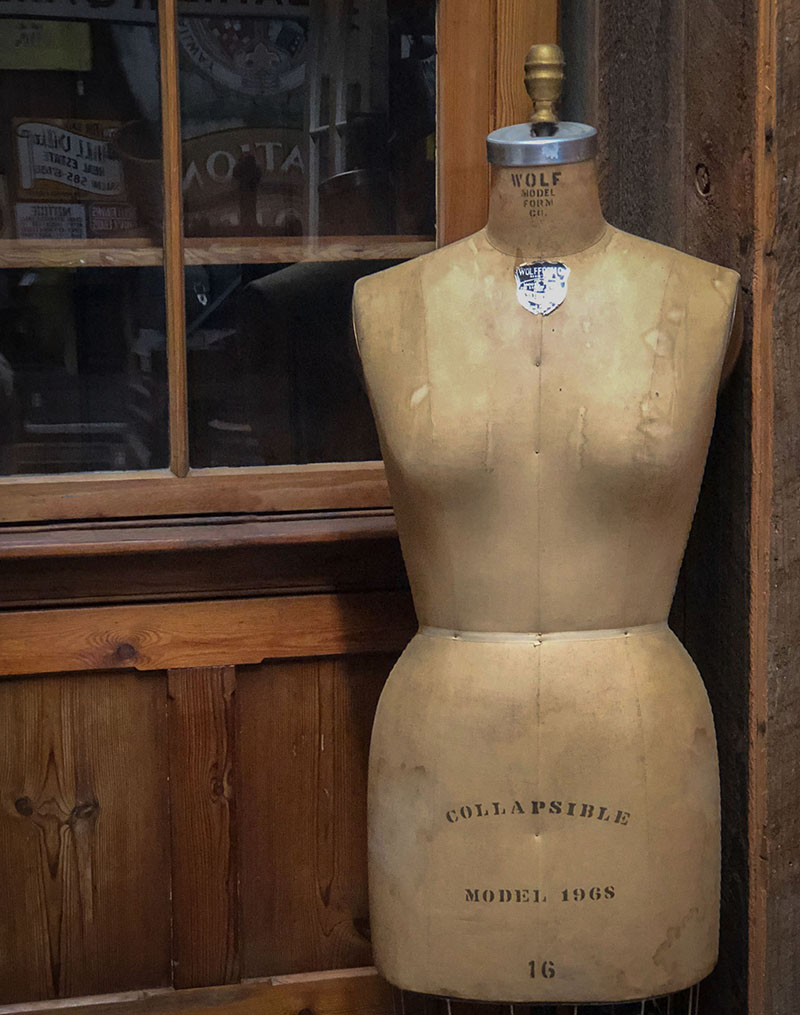
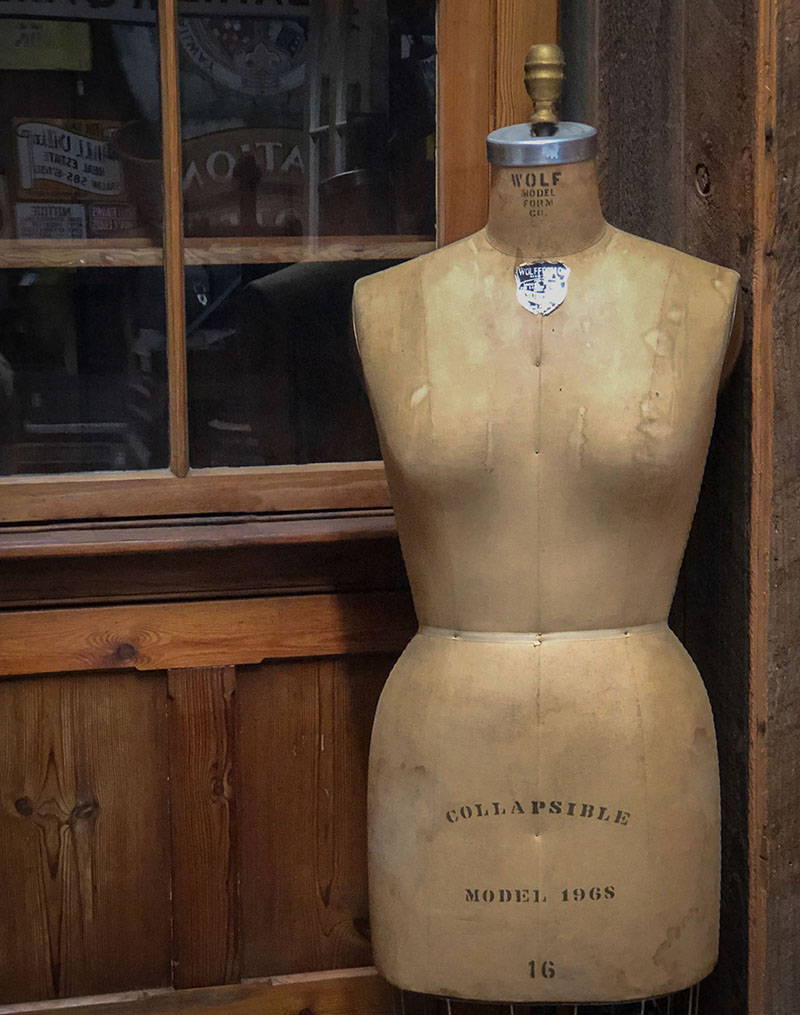
The yellow sign disappeared behind the timber post. And when it did, everything else settled. The rough-hewn post now frames the right edge — warm, dark, textured, quiet. The window behind the form opened up: wood mullions, the faint reflection of the room in the old glass, a stillness that wasn’t there before. The form leans slightly into the corner now, and that relationship — worn canvas, aged timber, old glass — is a conversation instead of a competition.
The stenciling reads clearly. The wear on the canvas surface holds your attention. The lamp socket and the badge and the slight asymmetry of the form’s posture — all of it is available now, because nothing is arguing with it.
This is the photograph.
What the Shift Actually Does
I didn’t change the light. I didn’t move the subject. I didn’t add anything or remove anything from the scene. I moved.
That’s the thing about position — it’s the one variable entirely under your control at any moment, in any environment. You can’t change where the sun is. You can’t rearrange a room full of antiques. But you can always move. A step left or right. Closer or further. Lower or higher. Each shift changes what aligns, what overlaps, what disappears, what opens up.
The scene didn’t change. What I could see from it did.
How This Connects to the Way I Work
Angles is one of the five principles at the core of the Intentional Image Method — the way of working I’ve developed over four decades of professional photography. It sits alongside Light, Simplicity, Lines, and Story. None of them are rules. They’re things to notice.
What these two images show is that Angles and Simplicity are often the same move. Changing your position simplifies by subtraction — not by touching anything in the scene, but by changing your relationship to it. The yellow sign didn’t go anywhere. I just stopped including it.
That’s a different kind of control than most people think about when they pick up a camera. And it’s available to you in every environment, with any camera, in any light.
The next time something catches your attention, before you raise the camera — move. Not far. Just enough to see what changes.
You might find the photograph was one step away the whole time.
— Patricia
Patricia Bean Photography · Intentional Image Method · Explore · Discover · Create
If this way of working is new to you, the Free Field Companion is where it begins.
Start by Seeing: A Field Companion