
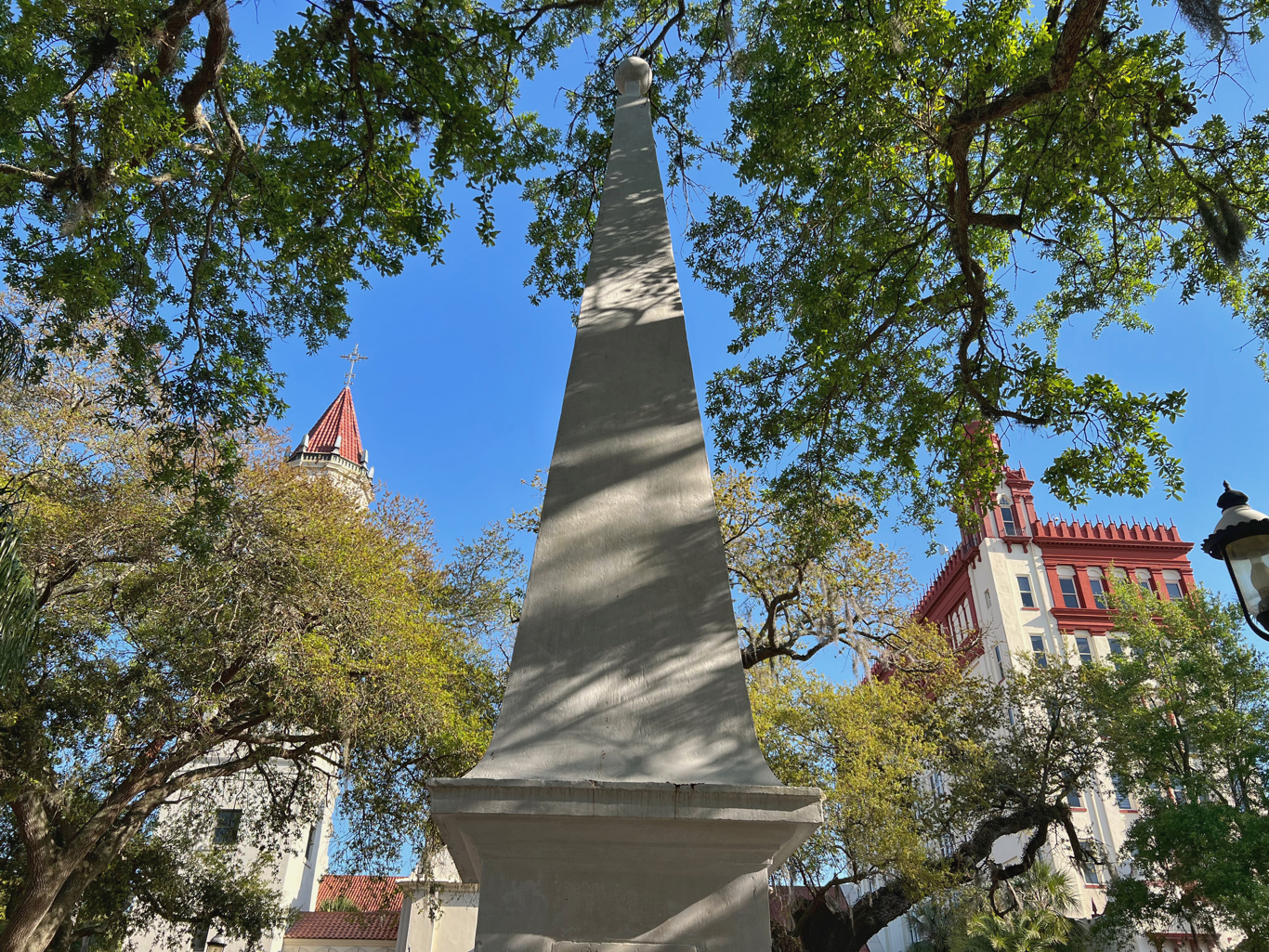
A lesson in seeing from the Plaza de la Constitución, Saint Augustine
There is a monument in the middle of Saint Augustine’s Plaza de la Constitución that most people photograph once and move on.
The 1812 Obelisk.
It commemorates the Spanish Constitution — a rare surviving monument that once limited the authority of both the monarchy and the church. Historically significant. Visually interesting. Easy to document.
Most people do exactly that. Document it. Then walk away.
But here is what the unhurried photographer finds.
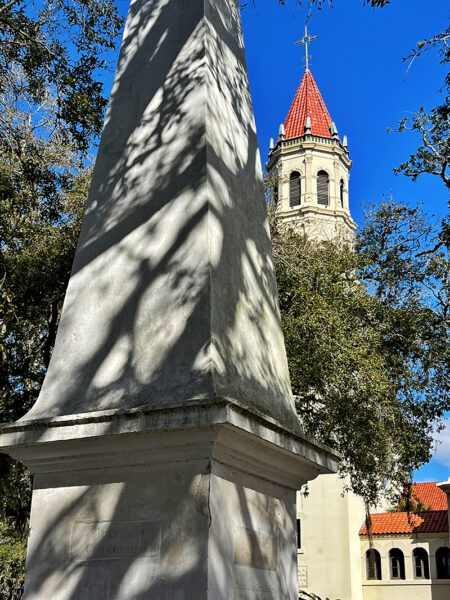
In the early morning, the obelisk is bathed in dappled light — the shadows of nearby trees tracing slow patterns across the stone. The texture comes alive in a way an overcast day or flat midday light will never reveal.
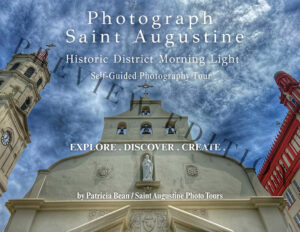
And when you take the time to move around it, change your position, and align yourself just right, the obelisk’s vertical line leads your eye directly up to the Cathedral’s cross rising behind it.
Two historic structures, separated by centuries, joined in a single frame.
A conversation across time.
That is not luck. That is learning to see.
Ken Blessing of Hedrich-Blessing — an architectural photography firm established in Chicago in 1929 — was quoted as saying, “Don’t make photographs — think them.”
This is at the heart of the Intentional Image Method™.
Before you raise your camera, ask yourself a few simple questions. Not rules — questions. They slow you down just enough to see what is actually in front of you.
THE METHOD — THREE QUESTIONS BEFORE YOU SHOOT
What is the light doing?
Is it flat or directional? Harsh or soft? Where are the shadows falling, and what are they revealing?
What patterns exist?
Look for shadows, repeating shapes, textures, and lines that lead the eye somewhere.
What relationship can I create?
Between foreground and background, near and far, the expected subject and what surrounds it.
The obelisk rewards patience.
Here is the thought process in real time: walk around it. Change your angle. Raise the camera above your head and watch how the lines shift. Notice the patterns the branches make and how they can frame the cross. Be sure to include the cross on the Cathedral tower.
Then look again.
Notice the repeated shapes in the windows. Look for small spots of color — red tiled roofs, a contrasting patch of blue sky. Watch how lines point, shapes repeat, and separate elements begin to relate to one another within the frame you are choosing.
Think: What is this image really about?
At that point, this is no longer simply a Cathedral and an obelisk. It becomes an image about pattern, color, shape, line, and relationship.
The image most people miss is there — it simply belongs to whoever is willing to stay a little longer and look a little harder.
I spent years walking these streets with guests, watching this happen in real time. Someone would arrive ready to photograph the obvious. By the end of our morning they were seeing relationships, light, and quiet details they had walked past their entire lives. The obelisk was one of my favorite places to teach this — because it looks simple until it isn’t.
I have since moved from Saint Augustine, but I carry these lessons with me everywhere I go. That is the nature of learning to see — it is not tied to a single place. The same questions that revealed the obelisk in a new light work just as well on a weathered fence post in Oregon, a doorway in Lisbon, or a fire escape in Chicago.
The method travels. So does the seeing.
YOUR CHALLENGE THIS WEEK
Find one ordinary object — a lamppost, a fence, a doorway — and photograph it three ways:
-
- Straight on
- From the side with a lower or higher angle
- Aligned with something behind it
Notice how the image changes completely with each shift. That is the Method working. That is you learning to see differently.
With warmth and light, Patricia
The Intentional Image Method™ is available now at Patricia Bean Photography — to explore at your own pace, wherever your travels take you.